
Dr. Lixing Chen | Global Business Strategy, Starvey Global
Abstract
Driven by rising pet humanization and expanding middle-class consumption, Southeast Asia’s pet care market is projected to grow at a 9% compound annual growth rate through 2028, outpacing most other global regions (Tretyakova & Puri, 2024). However, many overseas suppliers enter this market by replicating European or North American wholesale strategies, only to encounter unforeseen barriers: fragmented import regulations, foreign exchange controls, long market education cycles for pet tech, and hidden logistics risks for connectivity products. Drawing on public industry data and on-ground B2B trade observations from Starvey Global, this guide analyzes the structural realities of the Southeast Asian pet wholesale landscape, outlines five underdiscussed risks faced by distributors, and provides product-specific sourcing frameworks for IATA-compliant humane pet crates, 4G GPS tracking collars, and adjustable humane training collars. It further details small-batch trade term best practices and 2026 trade show execution strategies for Kuala Lumpur and Bangkok. The analysis concludes that compliance-certified, welfare-focused products deliver more stable long-term value for regional distributors than generic low-cost alternatives, when paired with localized logistics and payment structures.
Keywords: Southeast Asia pet wholesale, humane pet products, small-batch B2B sourcing, pet tech logistics, IATA pet crates
Introduction
Southeast Asia has emerged as one of the fastest-growing regional pet care markets worldwide, fueled by urbanization, rising disposable incomes, and the widespread adoption of pet humanization trends that originated in mature Western markets (Asia Briefing, 2023). For international pet product suppliers and regional distributors alike, this growth presents clear revenue opportunities — but it also carries undercommunicated operational and commercial risks that rarely appear in mainstream market forecasts.
Many new market entrants assume that Southeast Asian buyers prioritize only low pricing, and that product strategies successful in the European Union will translate directly to markets like Thailand, Vietnam, and Malaysia. In practice, however, distributors face fragmented national regulatory systems, variable customs enforcement, foreign exchange restrictions, and slower adoption rates for non-food pet products such as tech devices and premium travel gear. These gaps create hidden costs that erode margins for both suppliers and their wholesale partners.
This article combines third-party industry data with hands-on B2B trade experience from Starvey Global, a Hong Kong-based supplier of humane pet travel and safety solutions. It provides a practical, operation-focused guide for small-batch wholesale sourcing across three high-potential product categories: IATA-compliant airline crates, 4G pet GPS collars, and humane dog training systems. It also addresses common unspoken realities of regional distribution, trade term risk mitigation, and on-ground trade show strategy for 2026 industry events in Kuala Lumpur and Bangkok.
Southeast Asia Pet Wholesale Market: Growth Trajectory and Structural Realities
At a macro level, Southeast Asia’s pet care market has demonstrated exceptional resilience and expansion over the past decade. From 2018 to 2023, the region recorded a 13% compound annual growth rate in value, reaching an estimated $3.3 billion in total market size despite global cost-of-living pressures (Tretyakova & Puri, 2024). While growth is expected to moderate to a 9% CAGR between 2023 and 2028 as markets mature, this rate remains substantially higher than the Asia-Pacific average and most Western markets.
First of all, it is critical to contextualize this growth: approximately 90% of current market value comes from pet food, with non-food categories such as travel gear, tech, and training equipment still at relatively low penetration levels (Tretyakova & Puri, 2024). This creates a dual reality for wholesale suppliers: non-food categories have significant upside potential, but they require longer market education cycles and more localized go-to-market support than established food SKUs.
Secondly, growth is unevenly distributed across national markets. Thailand is the largest single market, accounting for nearly half of total regional pet care spending, while Indonesia and Vietnam are projected to deliver the fastest growth rates through 2028 (Euromonitor International, 2024). Each market operates under distinct import rules, product certification requirements, and foreign exchange regimes, meaning a one-size-fits-all regional wholesale strategy will consistently under perform.
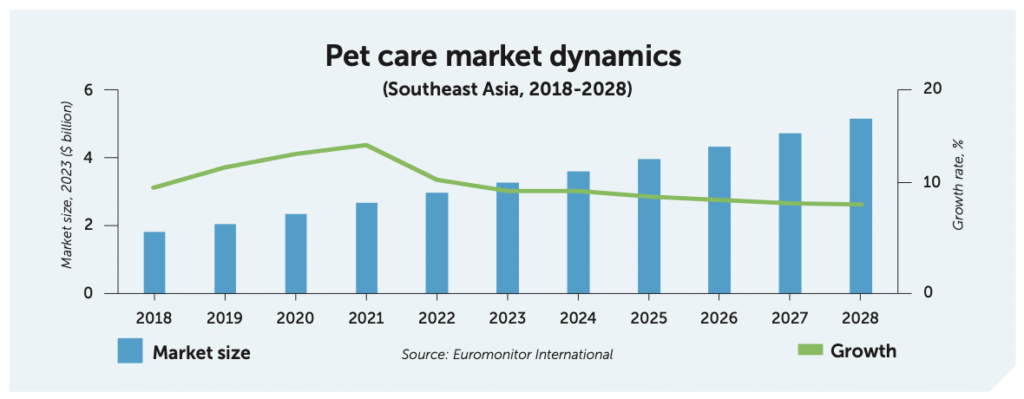
As illustrate table above, annual growth rates peaked around 2021 and have been gradually declining, but absolute market size continues to expand year over year. For wholesale distributors, this means competition will intensify as more international suppliers enter the market, making product differentiation through compliance, humane design, and reliable supply chains increasingly important — rather than competing solely on bottom-line pricing.
Thirdly, e-commerce is rapidly reshaping regional distribution channels. Online pet care sales are expected to double across Southeast Asia between 2023 and 2028, creating opportunities for smaller, niche distributors that focus on specialized premium products rather than mass-market commodity goods (Tretyakova & Puri, 2024). This shift favors suppliers that can support small-batch orders, drop-shipping capabilities, and localized marketing assets — a departure from the traditional full-container wholesale model.
Key Unspoken Realities for Wholesale Distributors in Southeast Asia
Beneath the headline growth numbers, regional distributors and importers face a set of operational realities that are rarely discussed in introductory market reports. Understanding these factors is critical for overseas suppliers seeking to build sustainable, low-risk partnerships in the region.
First of all, price sensitivity does not eliminate demand for quality and compliance. Many suppliers assume Southeast Asian buyers will always select the cheapest option, but in practice, low-cost white-label products carry substantial hidden costs. Customs detention due to missing certification, high product failure rates, and unavailable after-sales support all erode distributor margins and damage retail reputation. For non-food products in particular, buyers are increasingly willing to pay a moderate premium for items with verifiable safety certification and clear product documentation (Asia Briefing, 2023).
Secondly, import regulations are highly fragmented and inconsistently enforced. Unlike the European Union’s harmonized CE marking framework, each Southeast Asian country maintains its own product certification, labeling, and import licensing requirements. What clears customs in Malaysia may face delays or rejection in Thailand or Vietnam, and regulatory enforcement can vary significantly between ports. Distributors rarely disclose this complexity upfront to new suppliers, which can lead to unexpected delays and cost disputes after an order is placed.
Thirdly, small-batch trial orders are the standard, not the exception, especially for new product categories. Most regional distributors operate with limited warehouse capacity and conservative inventory strategies, particularly for pet tech and premium travel products that have unproven local demand. It is common for an initial order to be well below a standard factory minimum order quantity, followed by slow, incremental reorders as market demand is validated. Suppliers that demand large opening orders will struggle to build initial distribution partnerships in the region.
Fourthly, connectivity products such as cellular GPS pet collars face unique, underdiscussed logistics barriers. Devices that include SIM cards or cellular modules fall into a separate regulatory category in many Southeast Asian countries, with stricter import approval requirements and restrictions on bulk SIM card distribution. Many distributors do not fully understand these rules themselves, which can lead to shipments being seized at customs. For this product category, structuring shipments without pre-installed SIM cards and guiding buyers to source SIMs locally is almost always a lower-risk strategy.
Finally, many buyers request DDP (Delivered Duty Paid) shipping terms without fully accepting the corresponding liabilities. DDP can appear convenient for importers, but it requires the supplier to navigate local customs rules, duty calculations, and potential tax liabilities — all of which carry cost uncertainty. In markets with less transparent customs systems, DDP shipments can face unexpected fees that neither party anticipated, creating commercial disputes that damage long-term partnerships.
Product-Specific Sourcing Strategies for 2026
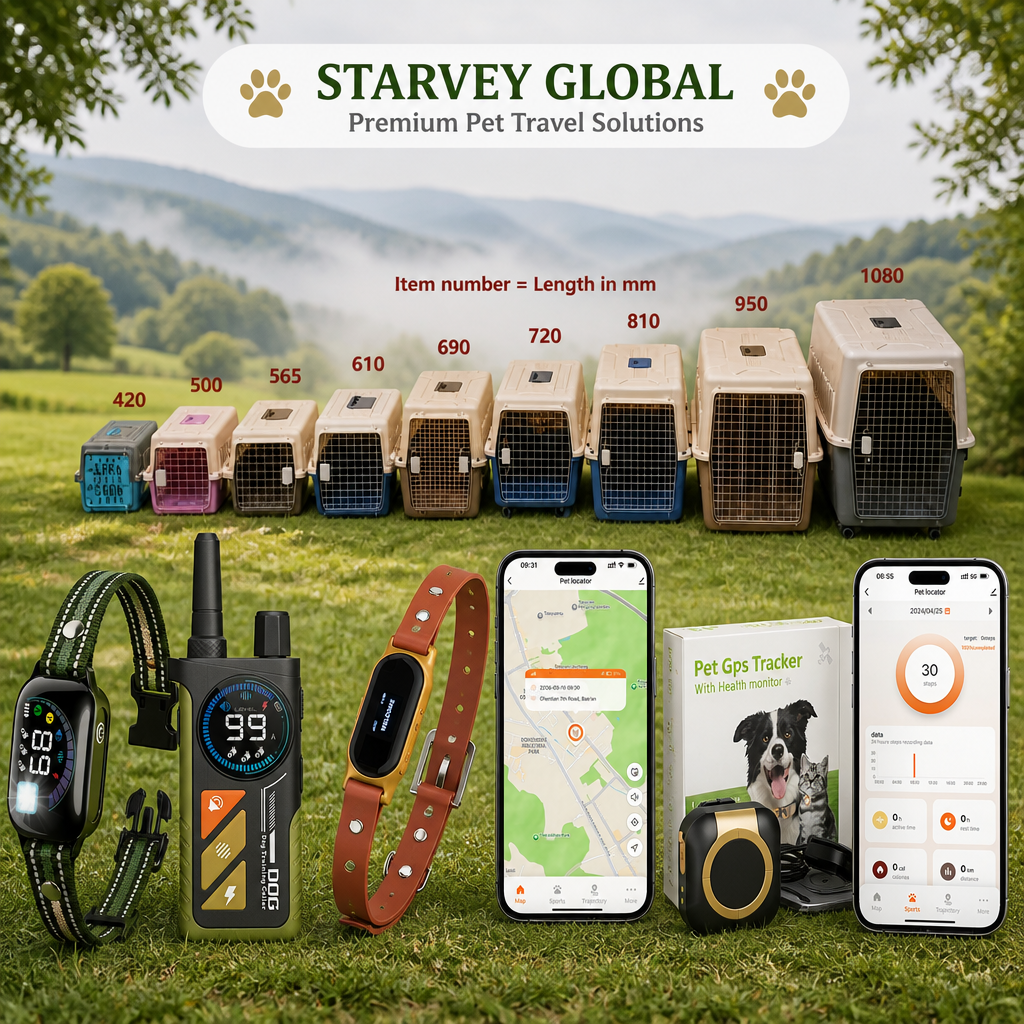
Three product categories offer particularly strong wholesale potential in Southeast Asia for 2026: IATA-compliant humane pet airline crates, 4G GPS pet tracking collars, and adjustable humane dog training systems. Each category requires a distinct sourcing and go-to-market approach aligned with local market maturity.
IATA-Compliant Humane Pet Air Crates: SG-CR-Series
Pet air travel and professional pet relocation services are growing steadily across Southeast Asia, driven by increasing international mobility and cross-border pet transport. IATA-compliant crates represent a mature, low-friction product category with well-understood performance standards, making them an ideal entry point for new distributors.
The Starvey Global SG-CR-Series of IATA airline crates is well suited for regional wholesale for three core reasons.
First of all, the upgraded flat-top panel design enables stable stacking during transit and storage, which is a high-priority feature for distributors managing limited warehouse space and multi-pet transport operators.
Secondly, the fully enclosed lower shell reduces direct airflow and provides additional structural security, while full perimeter ventilation maintains animal comfort — aligning with rising regional expectations for humane pet travel design.
Thirdly, the full size range covers cats, small companion dogs, and large working breeds, allowing distributors to stock a complete product line with a single supplier. All units meet IATA air transport standards, reducing customs clearance risk across regional markets.
4G Pet GPS Collars: SG-GPS-CB-C08 and SG-GPS-CB-C08PLUS
Pet safety and health monitoring technology is an emerging high-growth category in Southeast Asia, following adoption patterns already established in North America and Europe. However, market education remains a key barrier, and distributors prefer low-risk trial orders before committing to larger inventory.
The Starvey Global SG-GPS-CB-C08 and SG-GPS-CB-C08PLUS humane GPS collars address key regional pain points. The ultra-compact SG-GPS-CB-C08 weighs only 27.5g with a convenient crocodile clip design, making it suitable for cats and small dogs — a fast-growing demographic as urban cat ownership surges across the region (Tretyakova & Puri, 2024). The upgraded SG-GPS-CB-C08PLUS features multi-mode real-time positioning (GNSS, GPS, LBS, WiFi), customizable electronic geofence alerts, integrated activity and health monitoring, and a voice-recordable electronic nameplate. Both models use the free Tuya Smart app with no recurring subscription fees, which is a critical selling point for price-sensitive regional buyers.
From a wholesale logistics perspective, the detachable alert module design reduces animal burden and also simplifies shipping by separating the core tracker from collar accessories. All units carry full CE, FCC, and RoHS certification to support import compliance across Southeast Asian markets. For first-time orders, suppliers should recommend starting with mixed small batches and advise distributors to source local SIM cards independently to minimize customs risk.
Humane Dog Training Collars: SG-TR-PD509-TIO and SG-TR-PD511-TIO
Working dog populations and recreational dog training are widespread across Southeast Asia, creating steady demand for reliable training equipment. However, traditional static shock collars face growing ethical scrutiny in many markets, creating an opportunity for adjustable, welfare-focused training systems.
The Starvey Global SG-TR-PD509-TIO and SG-TR-PD511-TIO humane training collars deliver professional-grade performance while prioritizing canine welfare. They offer 9 selectable sound prompts, 16 vibration levels, and 1–99 adjustable static levels, plus an AI-powered automatic anti-bark function — allowing handlers to match stimulation intensity to each dog’s size, temperament, and training progress. With a 1000-meter remote range, support for 2–3 dogs per remote, and IPX7 full waterproof rating, these collars are suitable for both professional trainers and farm operators.
For wholesale distributors, these models offer two key advantages: they carry full CE certification for simplified import, and they fit into both pet retail and working dog supply assortments. This broad applicability reduces inventory risk and increases the addressable customer base for regional stockists.
Small-Batch B2B Trade Terms and Risk Mitigation Framework
For small-batch wholesale orders in Southeast Asia, structuring trade terms and payment conditions correctly is more important than maximizing per-unit margin, as it directly impacts cash flow risk and dispute probability.
First of all, select trade terms that match order size and local logistics capability. For most small trial orders, EXW (Ex Works) pricing is the most transparent and low-risk option for suppliers, with the buyer arranging their own freight and customs clearance. For larger repeat orders, FCA (Free Carrier) terms at a Hong Kong warehouse can offer a good middle ground: it simplifies the export process for the supplier while still giving the buyer control over international shipping and destination clearance. DDP terms should be approached with caution and only accepted when the supplier has verified local customs costs and reliable last-mile partners.
Secondly, use structured payment terms to reduce default risk. A standard 50% deposit with the remaining 50% paid prior to shipment is the most appropriate baseline for small-batch pet product orders to Southeast Asia. This structure protects suppliers against order cancellations and foreign exchange fluctuation risk, while still being reasonable for buyers. Lower deposit ratios, such as 30%, are not recommended for new customers in markets with foreign exchange controls, as they leave the supplier exposed to last-minute order changes or non-payment.
Thirdly, provide complete, standardized documentation with every shipment. This includes a proforma invoice (PI), commercial invoice (CI), sales contract, packing list, and certificate of origin (CO) where applicable. Clear, professional documentation speeds up customs clearance and reduces the risk of unexpected duty charges, which in turn improves the buyer’s experience and likelihood of reordering.
On-Ground Trade Show Strategy for Kuala Lumpur and Bangkok 2026
Industry trade shows remain the most effective channel for building new wholesale partnerships in Southeast Asia, as face-to-face relationship building carries significant weight in regional business culture. For suppliers participating as walk-in exhibitors without standard booths, a targeted strategy is required to generate qualified leads.
First of all, prioritize lead quality over lead quantity. Walk-in exhibitors will not generate the same foot traffic as booth holders, so focus on engaging with attendees who match your ideal customer profile: established distributors, pet retail chain buyers, and professional pet service operators. Collect detailed contact information and take brief notes on each prospect’s specific product interests, rather than distributing large volumes of free samples to casual passersby.
Secondly, structure sample distribution strategically. Free samples can help close deals, but they should only be provided to high-intent prospects after a substantive conversation. For general inquiries, direct buyers to your website and digital product catalog first, and offer paid sample options with a sample credit applicable to future bulk orders. This filters out low-intent tire-kickers and ensures sample investment goes toward leads with real purchase potential.
Thirdly, follow up systematically within 72 hours of the show. Regional buyers often attend multiple events and speak with many suppliers, so timely, personalized follow-up is critical to remaining top of mind. Segment leads by product category and intent level, and tailor follow-up messages accordingly — for example, sending detailed wholesale pricing and MOQ information to high-intent distributors, and general product brochures to exploratory contacts.
Conclusion
Southeast Asia’s pet care market offers substantial growth opportunities for international pet product suppliers and regional wholesale distributors, but success requires a localized, reality-based strategy rather than direct replication of Western market playbooks. While headline growth rates are impressive, the market is still dominated by pet food, non-food categories have longer education cycles, and regulatory and logistical complexity is higher than many new entrants anticipate.
For 2026, the most sustainable approach to Southeast Asian wholesale is to focus on compliance-certified, humanely designed products, support small-batch trial orders, structure payment and shipping terms to minimize mutual risk, and build relationships through in-person industry events. Product lines such as the Starvey Global SG-CR-Series IATA crates, SG-GPS-CB-C08/C08PLUS GPS collars, and SG-TR-PD509-TIO/PD511-TIO training collars align well with these criteria, offering verifiable quality, broad market applicability, and the certification documentation required for regional import.
As the market continues to mature, distributors that prioritize transparent partnerships, reliable supply chains, and welfare-focused product assortments will outperform competitors that compete solely on price. For suppliers, investing in localized logistics support and clear compliance documentation will deliver greater long-term returns than short-term price cutting.
References
Asia Briefing. (2023, October 12). Southeast Asia’s pet care industry offers opportunities for foreign firms. https://www.asiabriefing.com/news/?s=Southeast+Asia%E2%80%99s+pet+care+industry+
Euromonitor International. (2024). Pet care in Southeast Asia. https://www.euromonitor.com/search?term=Pet+care+in+Southeast+Asia
Tretyakova, E., & Puri, S. (2024, March 28). Regional report: Southeast Asia – Rapid market expansion and room for growth. Global Pet Industry. https://globalpetindustry.com/article/regional-report-southeast-asia-rapid-market-expansion-and-room-for-growth/