

By Dr. Lixing Chen (Star Lee), DBA | Global Business Strategy, Starvey Global
Abstract
The South African pet products market, valued at USD 55 million in 2025, is projected to grow at a compound annual growth rate (CAGR) of 4.53% through 2032, presenting tangible opportunities for global wholesale distributors and cross-border suppliers. However, market entry barriers including layered import regulations, channel-specific demand preferences, and an offline-dominant retail landscape create uncertainty for new entrants. This article analyzes 2025–2026 market data, regulatory frameworks, and category-specific demand trends to deliver actionable guidance for pet product distributors targeting the South African market. Findings indicate that IATA-compliant pet travel crates, humane dog training collars, and 4G pet GPS trackers represent high-growth product segments, while verifiable regulatory compliance remains the primary differentiator for competitive advantage. The paper concludes with a tiered sourcing strategy and SKU-specific recommendations aligned with South Africa’s market structure and evolving pet humanization trends.
Introduction
Over the past decade, South Africa has emerged as one of the steadiest-growing pet care markets in sub-Saharan Africa, driven by rapid urbanization, a growing middle class, and a sustained cultural shift toward pet humanization (Vyansa Intelligence, 2025). Unlike saturated North American and European markets, South Africa’s pet product ecosystem remains heavily weighted toward offline retail, with independent pet stores and supermarket chains controlling 85% of total sales. This structure creates distinct opportunities for wholesale distributors that can supply curated, compliance-verified product assortments to brick-and-mortar retailers.
However, market entry requires more than competitive pricing. Import procedures for pet products and live animal transport are governed by strict veterinary and safety regulations, and non-compliance can result in delayed customs clearance, product returns, or reputational damage with retail partners (VetSaglik, 2026). For many new distributors, the biggest challenge is not identifying demand, but matching product specifications to local regulatory requirements and channel expectations.
This guide addresses this gap by synthesizing the latest market intelligence, import regulatory updates, and on-the-ground category insights. It first outlines the overall market trajectory and competitive structure, then breaks down compliance requirements for core product categories, and finally provides SKU-specific recommendations and sourcing strategies for wholesale entrants. The analysis focuses on three durable product lines—pet airline crates, dog training collars, and GPS trackers—where import penetration is highest and domestic manufacturing capacity remains limited.
1. Market Overview and Growth Trajectory
1.1 Market Size and Forecast
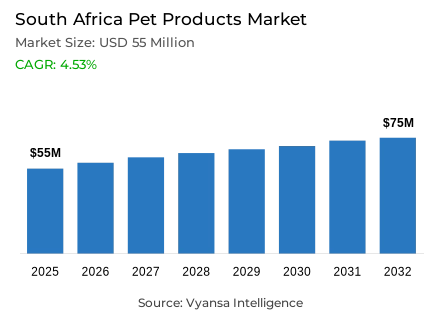
The South African pet products market reached USD 55 million in 2025 and is on track to expand to USD 75 million by 2032, representing a CAGR of 4.53% over the forecast period (Vyansa Intelligence, 2025). This steady, low-volatility growth is underpinned by three core drivers: rising urban pet ownership, increasing consumer emphasis on pet health and well-being, and the gradual expansion of premium pet retail channels.
1.2 Market Structure and Channel Dynamics
From a category perspective, pet healthcare accounts for the largest revenue share at 35%, driven by demand for flea and tick treatments, dietary supplements, and parasite control products (Vyansa Intelligence, 2025). While consumables dominate by volume, durable and tech-enabled pet products—including travel gear, training devices, and smart trackers—are growing faster than the market average, as younger consumers (millennials and Gen Z) seek innovative, high-quality solutions for their pets.
From a channel perspective, offline retail retains an 85% market share, with pet specialty stores and superstore chains serving as the primary distribution points. E-commerce, while still small, is the fastest-growing channel, fueled by the expansion of online grocery delivery and increased digital adoption among urban consumers. This dual-channel structure means wholesale distributors must optimize assortments differently: offline channels prioritize value, durability, and in-store display appeal, while online channels lean toward feature-rich premium products.
A key industry observation is that the top five domestic players control only 55% of the market, leaving significant white space for international suppliers—particularly in specialized durable categories where local manufacturing capacity is limited (Vyansa Intelligence, 2025). Unlike commoditized products such as cat litter and basic treats, premium travel and tech pet products rely heavily on imported supply chains, creating a clear entry point for global wholesale brands.
2. Pet Import Regulatory Landscape and Compliance Risks
2.1 Core Regulatory Framework
South Africa maintains one of the stricter pet import regulatory systems in Africa, overseen by the Department of Agriculture, Land Reform and Rural Development (DALRRD). While these rules apply most directly to live animal imports, they create cascading requirements for pet travel products—most notably airline crates used for international and domestic pet transport.
For live pet entry, mandatory documentation includes a Veterinary Import Permit, ISO-compatible microchip identification, rabies vaccination with verified timing, and an official Veterinary Health Certificate issued within 10 days of travel (VetSaglik, 2026). Dogs face additional requirements, including blood tests for specific pathogens and possible authorization under the Animal Improvement Act. These rules directly shape product demand: pet relocation services and owners will only purchase crates that meet IATA standards to avoid being turned away at airport check-in.
2.2 Compliance as a Competitive Differentiator
A common and costly pitfall for new wholesale entrants is treating product compliance as a checkbox exercise rather than a core value proposition. In the South African market, where small retailers and pet owners have limited experience navigating import rules, distributors that supply pre-verified, fully compliant products gain significant trust and pricing power.
For example, Starvey Global SG-CR-565 and SG-CR-810 IATA-compliant pet airline crates are engineered to meet full IATA Live Animal Regulations and major airline specifications. Each unit features food-grade PP construction, a reinforced stainless steel door, detachable transport casters, and integrated water and food bowl systems. For wholesale buyers, this means no retrofitting, no airport rejections, and a product that can be marketed immediately to pet relocation agencies, veterinary clinics, and retail pet stores.
This is particularly relevant in South Africa, where many low-cost imported crates are marketed as “IATA-approved” but fail dimensional strength and ventilation requirements. Distributors that can provide verifiable compliance documentation reduce customer risk and build long-term loyalty—a competitive moat that is far more durable than low pricing alone.
3. High-Potential Product Lines for South African Wholesale
3.1 IATA-Compliant Pet Airline Crates
Pet relocation and air travel demand continues to rise in South Africa, driven by international migration, domestic job mobility, and growing participation in dog shows and sporting events. Medium to large breed dogs are particularly popular, creating steady demand for crate sizes 420 through 1080.
The Starvey Global SG-CR-565 (medium breed) and SG-CR-1080 (medium-large breed) represent the highest-volume SKUs for wholesale distribution. Their standard IATA sizing fits most common domestic dog breeds, while their durable construction withstands the handling conditions of South African airport cargo terminals. For commercial pet transport operators, the consistent sizing and stackable design also optimize cargo space utilization.
3.2 Humane Remote Dog Training Collars
South Africa has a large population of working farm dogs, guard dogs, and outdoor companion dogs, creating consistent demand for behavior correction and training tools. At the same time, rising animal welfare awareness is shifting buyer preference away from traditional single-mode shock collars toward adjustable, humane training systems.
The Starvey Global SG-TR-PD509-TIO and SG-TR-PD511-TIO 2-in-1 humane training collars address both trends. With IPX7 full waterproofing, they perform reliably in South Africa’s rainy regions and outdoor farm environments. The 9 adjustable tone modes, 16 precision vibration levels, and 1–99 customizable static intensity levels allow trainers to tailor correction to each dog’s temperament, aligning with humane training standards. Both models carry CE and FCC certifications, simplifying import clearance, and the 1000-meter remote range is well-suited for the farm and open-land training scenarios common across much of the country.
3.3 4G Pet GPS Trackers
As pet owners increasingly treat animals as family members, demand for real-time location tracking and activity monitoring has grown rapidly. This trend is amplified in South Africa by the country’s large rural and suburban areas, where dogs roam over wider areas and face higher loss risk.
The Starvey Global SG-GPS-CB-C08, SG-GPS-CB-C08PLUS, and SG-GPS-CB-PX 4G pet GPS trackers cover all price points and use cases. The entry-level C08 targets general retail and everyday pet safety, offering real-time tracking, geo-fencing, and basic activity monitoring via the free Tuya app. The C08PLUS adds improved battery life and positioning accuracy for professional pet logistics operators. The premium PX model features IP66 full waterproofing and built-in two-way audio, designed for working dogs, farm deployments, and extreme outdoor environments. All three models are compatible with South Africa’s major mobile networks, making them ready for immediate deployment.
4. Sourcing Strategy for Wholesale Distributors
4.1 Phased Market Entry
Given South Africa’s moderate market size and channel fragmentation, new distributors are advised to adopt a phased entry strategy rather than launching a full product line upfront. Starting with small-batch trial orders allows buyers to validate sell-through rates, test channel preferences, and navigate import procedures without excessive inventory risk.
For initial orders, a minimum of 50 units of IATA crates and 200 units of electronic training or tracking products is recommended. This MOQ balance aligns with typical wholesale order sizes in the market and allows distributors to test 2–3 SKUs per category.
4.2 Supplier Selection Criteria
When evaluating international suppliers, South African distributors should prioritize three factors:
- Verifiable certifications: All electronic products must carry CE and FCC certification; pet crates must meet IATA standards. Suppliers that provide full test reports and compliance documentation reduce customs delay risk.
- Flexible order terms: Suppliers that offer mixed-SKU MOQs and EXW/FOB shipping terms give distributors greater inventory flexibility.
- Market-aligned product specifications: Products must be sized and featured for South African use cases—for example, long-range training collars for farms, waterproof designs for outdoor exposure.
Starvey Global meets all three criteria, with a full portfolio of certified pet travel, training, and tracking products, flexible wholesale MOQs, and experience supplying to African and emerging markets.
4.3 Channel-Aligned Assortment Planning
To maximize market penetration, distributors should differentiate assortments by channel. For offline pet stores and superstores, prioritize mid-tier, value-focused SKUs such as the SG-CR-565 crate and SG-TR-PD509-TIO training collar. For online channels and professional B2B customers (pet relocation companies, training facilities), position premium SKUs including the SG-CR-690 crate and SG-GPS-CB-PX tracker with full feature sets and compliance documentation.
Conclusion
The South African pet products market offers steady, predictable growth for wholesale distributors that navigate its unique regulatory and channel landscape correctly. While the market is smaller than mature North American or European markets, its limited domestic manufacturing base and strong demand for durable, tech-enabled pet products create favorable conditions for international suppliers.
Success in this market hinges on two core pillars: first, prioritizing regulatory compliance and product certification as a competitive advantage rather than a cost center; second, aligning product assortments with South Africa’s offline-dominant retail structure and high share of outdoor and working dog populations. IATA-compliant pet crates, humane multi-mode training collars, and 4G GPS trackers represent the three highest-potential entry categories, each addressing a clear, unmet market need.
By adopting a phased entry strategy, starting with small-batch trial orders, and partnering with suppliers that understand local market requirements, distributors can build sustainable market positions and capture share ahead of broader international competition.