By Dr. Lixing Chen (Star Lee), DBA | Global Business Strategy, Starvey Global
Abstract
The global cross-border pet transport industry has experienced sustained growth in the post-pandemic era, driven by rising international migration, pet humanization trends, and demand for premium pet travel services. However, tightening enforcement of the International Air Transport Association (IATA) Live Animals Regulations (LAR) has led to increased pet shipment rejection rates at major global airlines, with non-compliant transport crates identified as the leading cause of transit risks and denied boarding. This article analyzes the 2026 52nd edition updates to the IATA LAR, dissects airline-specific crate specifications using Lufthansa as a benchmark, and evaluates standard sizing frameworks for pet carriers. It further argues that physical crate compliance alone is no longer sufficient to mitigate transit risks and address pet owner anxiety, and that integrated smart tracking technology represents the next evolution in humane pet air travel. Finally, the paper provides three actionable strategies for pet relocation companies: standardizing compliant crate inventory, developing premium tracked service packages, and implementing pre-flight dual-verification processes. Findings indicate that combining full IATA structural compliance with 4G GPS tracking can reduce operational liability, increase service margins by 20–30%, and improve customer trust.
Introduction
Over the past decade, pets have transitioned from companion animals to core family members for a growing share of households worldwide, a shift that has reshaped demand for pet travel and relocation services. The post-pandemic recovery of global migration, cross-border work assignments, and international pet tourism has further accelerated growth in the air pet transport sector, with market projections indicating consistent compound annual growth across North America, Europe, and Southeast Asia. Unlike general cargo, live animal transport requires high-touch handling and specialized equipment, creating a high-barrier, high-margin segment for service providers.
Industry analysis shows that premium pet travel services—including door-to-door relocation, customs clearance, and flight booking support—are growing faster than standard cargo options, as pet owners are willing to pay a premium for reduced stress and guaranteed safety. This willingness to spend creates an opportunity for relocation companies to differentiate themselves not just through service quality, but through equipment quality and transparency.
Alongside this demand surge, however, comes heightened regulatory scrutiny: global airlines are enforcing live animal transport standards more rigorously than ever before, citing safety risks associated with under performing or improperly sized pet crates. For pet relocation service providers, retail distributors, and logistics operators, staying current with IATA-LAR updates and airline-specific mandates is no longer optional—it is a core operational requirement. Non-compliant crates result in denied boarding, costly re-booking fees, reputation damage, and in worst-case scenarios, harm to the animals in transit.
Beyond physical crate standards, a separate gap has emerged: even fully compliant crates cannot eliminate transit uncertainty, such as misrouted shipments, lost baggage tags, or extended layovers with no status updates for pet owners. This guide examines the current state of IATA pet crate compliance as of 2026, breaks down mandatory structural and dimensional requirements, and explains how smart wearable technology is extending compliance beyond the crate itself. It is structured to first establish the market and regulatory context, then dissect technical specifications, address industry pain points, and conclude with practical, profit-focused recommendations for B2B pet relocation stakeholders.
1. Market Overview and Future Trends in Air Pet Travel
1.1 Post-Pandemic Growth in Cross-Border Pet Transport
The global pet relocation market entered a period of accelerated expansion following the lifting of international travel restrictions in 2022–2023. Two primary forces drive this growth: first, the resumption of skilled migration and expatriate assignments, which commonly involve family pet relocation; second, the rise of pet-friendly international tourism, particularly among high-income households that prioritize traveling with their animals. Unlike general cargo, live animal transport requires high-touch handling and specialized equipment, creating a high-barrier, high-margin segment for service providers.
Premium pet travel services—including door-to-door relocation, customs clearance, and flight booking support—are outpacing standard cargo options in growth. Pet owners consistently demonstrate willingness to pay a price premium for reduced stress and guaranteed safety, creating clear space for service differentiation through equipment quality and process transparency.
1.2 Tightening Regulatory Enforcement by Global Airlines
Major international carriers including Delta Air Lines, Lufthansa, and Emirates have all updated their live animal acceptance policies since 2024, with a clear trend toward stricter crate inspections at check-in. The primary driver of this tightening is risk mitigation: improperly constructed crates have been linked to pet escapes, injury, and even mortality during air transit, exposing airlines to liability and reputational harm.
Under the 52nd edition of the IATA Live Animals Regulations (2026), updated requirements for container construction, ventilation, and labeling create a more uniform global baseline, but many airlines impose additional, more restrictive rules. For example, Lufthansa explicitly warns that crates purchased before 2024 may no longer meet current standards and will be refused at check-in (Lufthansa, n.d.). This regulatory drift means that relocation companies with older crate fleets face growing rejection risk unless they update their inventory.
1.3 The Shift From Physical Compliance to Digital Visibility
Historically, IATA compliance has been defined entirely by physical attributes: crate size, material strength, ventilation, and locking mechanisms. While these factors remain non-negotiable, they only address safety inside the crate. They do not resolve the largest source of pet owner anxiety: uncertainty about the pet’s location and well-being during 10–20 hour international journeys, including transfers between terminals, connecting flights, and ground handling.
This gap is driving a new generation of “digitally enabled” pet transport solutions, where IATA-compliant crates are paired with compact, waterproof GPS trackers. This evolution represents a shift from passive compliance to active risk management. For relocation providers, digital visibility is no longer a niche luxury feature—it is rapidly becoming a customer expectation and a competitive differentiator in the premium relocation segment.
2. Hard Specification Breakdown: IATA LAR and Airline Mandates for Pet Crates
2.1 Dimensional Standards: The IATA Sizing Formula and Breed Reference
The foundational principle of IATA crate sizing is that every animal must be able to stand, turn around, and lie down in a natural position inside the crate. The official IATA sizing formula uses three core measurements from the pet:
- Length: length from nose to base of tail + ½ the height of the front leg
- Width: width across the shoulders × 2
- Height: height from floor to top of head or ears (whichever is higher) when standing naturally
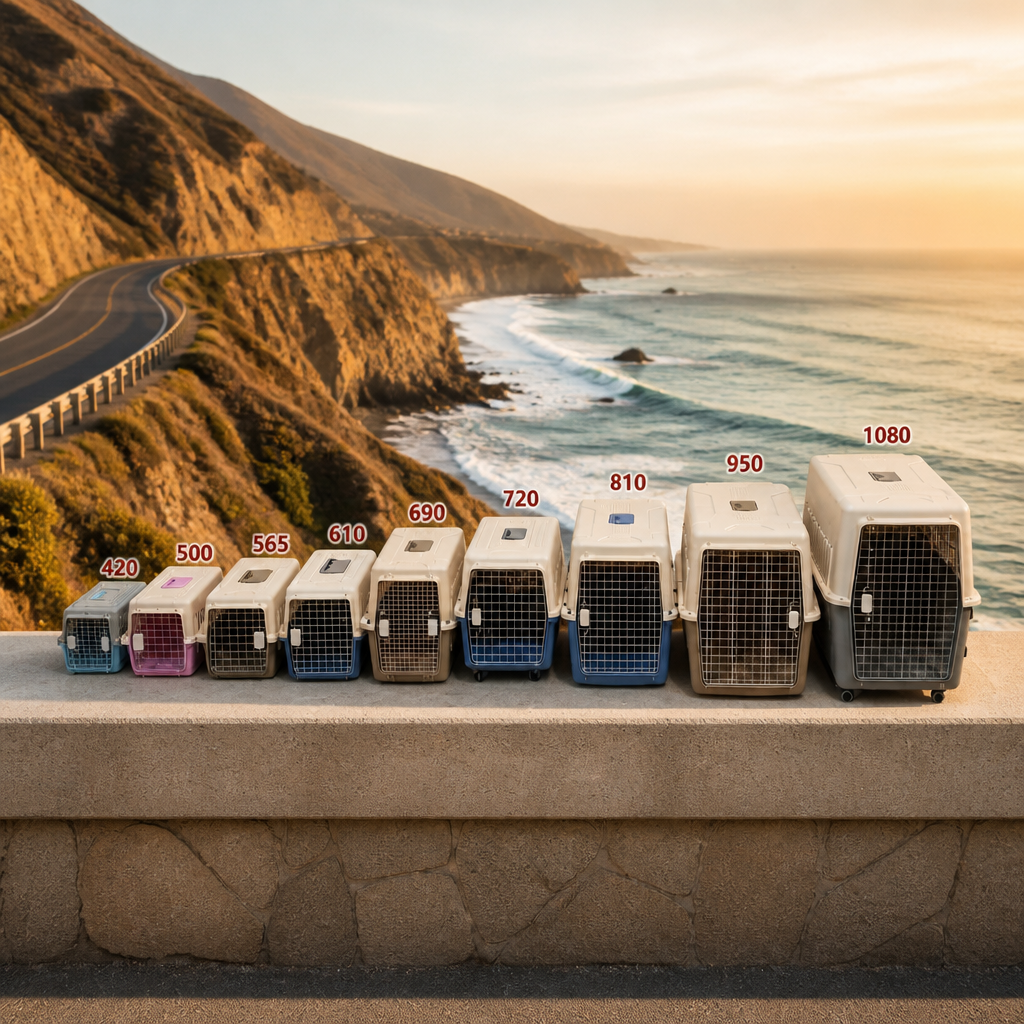
These minimum internal dimensions ensure the animal can adjust position during long flights and avoid stress or physical injury. While exact measurements always depend on the individual animal, industry reference tables help relocation companies and pet owners estimate appropriate crate sizes based on common breeds. Table 1 presents a standardized size guide for IATA-compliant pet crates, ranging from small carriers for cats and miniature dogs to giant kennels for large working breeds.
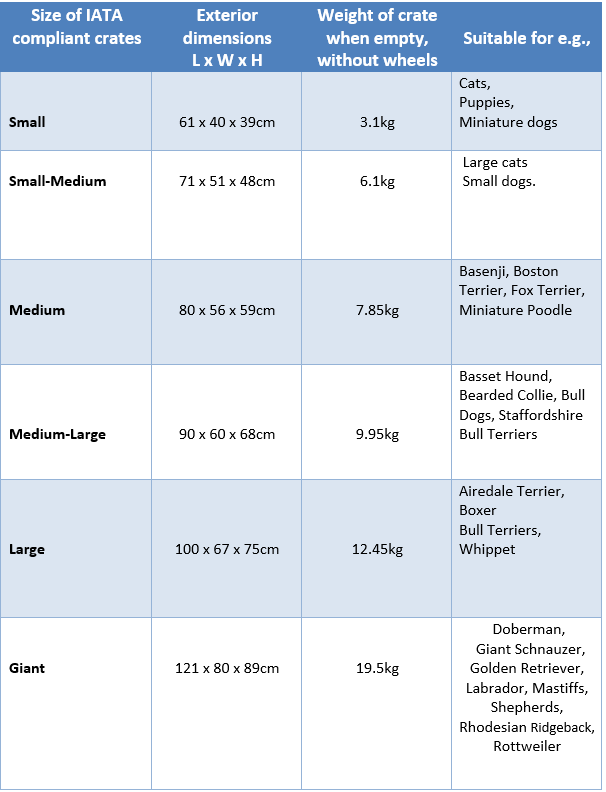
This table serves as a starting point, but relocation professionals should always measure each pet individually, as body proportions vary even within the same breed. Using an undersized crate is one of the most common reasons for airline rejection, as it violates IATA animal welfare requirements.
2.2 Construction and Material Requirements: 2026 Non-Compliance Pitfalls
The 2026 IATA LAR updates and recent airline policy changes have raised the bar for crate construction quality. Based on analysis of IATA standards and Lufthansa’s implementation rules, the following construction features are mandatory for cargo-hold pet transport, and failure to meet them will result in denied boarding:
First of all, fastening systems: The upper and lower halves of the crate must be secured with metal bolts and nuts. Plastic clips, snap-on latches, or all-plastic locking mechanisms are explicitly prohibited by most major airlines, as they can fail under impact or temperature fluctuations (Lufthansa, n.d.). This is one of the most frequent reasons pre-2024 crates are rejected.
Secondly, door locking mechanisms: Doors must feature dual-point or multi-point spring-loaded metal latches. Simple single press-button latches or plastic door fasteners do not provide sufficient escape protection, particularly for anxious or strong-chewing breeds.
Thirdly, structural integrity: Crates must be constructed from rigid, impact-resistant material such as food-grade polypropylene. Wire-mesh crates and crates with wire tops are not accepted for air cargo transport, as they do not provide sufficient protection from shifting cargo.
2.3 Mandatory Accessories and Ventilation Rules
Ventilation is a critical safety factor regulated by both IATA and individual airlines. IATA requires ventilation on all four sides of the crate, with total ventilation area equal to at least 16% of the total surface area. Lufthansa adds further granularity: ventilation openings must not exceed 25 mm × 25 mm for dogs and 19 mm × 19 mm for cats, to prevent paws, noses, or claws from protruding through the openings and sustaining injury (Lufthansa, n.d.). All ventilation openings must be located in the upper two-thirds of the crate wall.
In terms of accessories, two items are required by nearly all airlines: a fixed water bowl and a fixed food bowl, both mounted on the inside of the door and refillable from outside without opening the crate. Absorbent bedding is also required, but materials such as newspaper, cat litter, or loose straw are prohibited under IATA rules, as they can shift or create respiratory issues during flight. Spacers (formerly called spacer bars) must be built into the crate design to keep ventilation openings clear of surrounding cargo and to serve as handling grips (International Air Transport Association [IATA], 2026).
3. The Limitations of Physical-Only Compliance: Why Smart Tracked Crates Are the Next Standard
3.1 The Hidden Risks of Air Pet Transit Beyond Crate Design
Even a perfectly IATA-compliant crate cannot eliminate all risks in the air transport chain. Industry observation shows that a significant share of pet relocation incidents are not caused by crate failure, but by logistics errors: misrouted baggage, lost shipping labels, incorrect transfer between terminals, and extended layovers where the pet’s status is unknown. For international flights with connections, pets can change hands between multiple ground handling teams, creating information gaps that neither the airline nor the relocation company can easily resolve.
These logistics risks create two layers of cost for relocation providers: first, the operational cost of locating and rerouting a misrouted pet; second, the reputational cost of a distressed pet owner with no updates for 12+ hours. Physical compliance prevents injury inside the crate, but it does nothing to prevent process failures outside the crate.
3.2 Trust Gaps Between Pet Owners and Relocation Providers
Pet owners shipping animals internationally typically experience high levels of anxiety throughout the journey. Unlike regular cargo, pets are sentient family members, and owners often describe the transit period as emotionally distressing. Relocation companies that can only offer “your pet is on the flight” as an update struggle to differentiate themselves from lower-priced competitors, because they cannot prove their service quality during transit.
This trust gap is particularly pronounced in the premium market segment, where clients pay premium rates but receive the same level of visibility as economy pet shipping. For relocation businesses, closing this gap is both a customer satisfaction imperative and a revenue opportunity.
3.3 Integrating GPS Technology With IATA-Compliant Housings
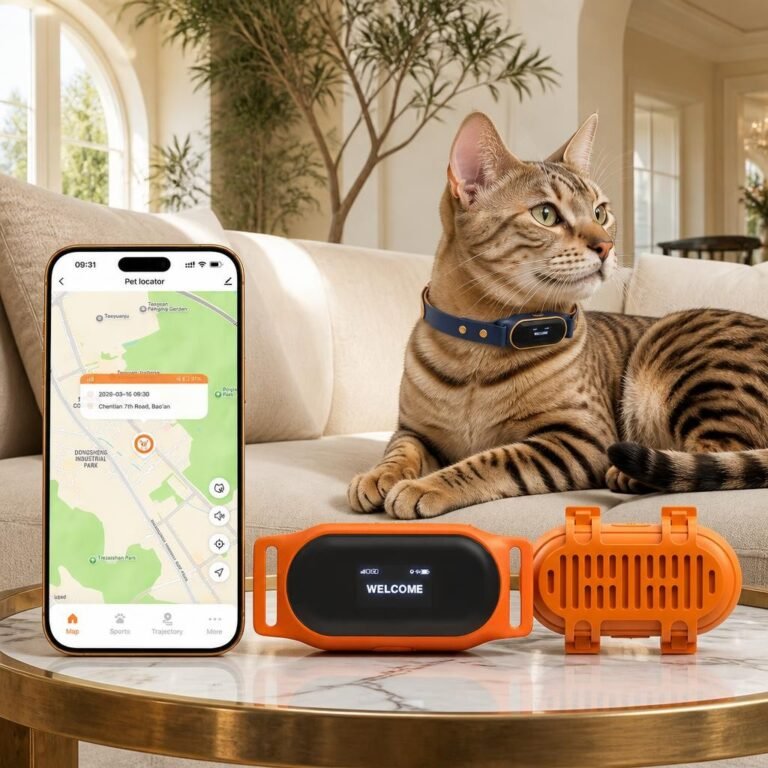
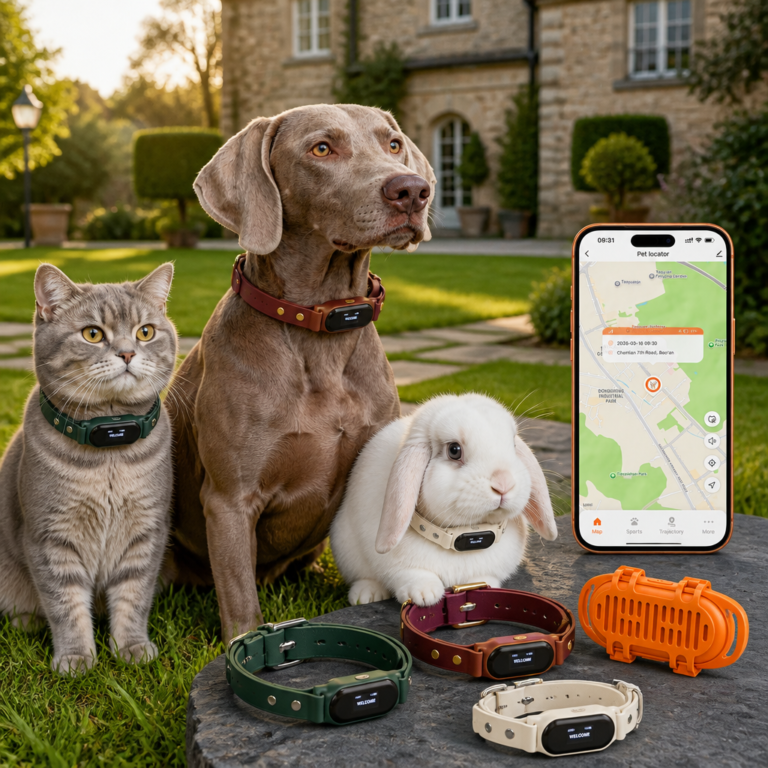
The solution to the visibility gap is to integrate compact, long-lasting GPS tracking devices directly into IATA-compliant crate setups. Products such as the Starvey Global SG-GPS-CB-C08PLUS pet tracking collar can be safely worn by the pet inside the crate without interfering with space requirements, or mounted discreetly inside the crate structure. These devices provide real-time location tracking via 4G multi-mode positioning (GNSS, GPS, LBS, and Wi-Fi), allowing both relocation staff and pet owners to view the pet’s journey on a map.
Beyond basic location tracking, modern devices include additional welfare features such as activity monitoring and electronic geofence alerts, which notify managers if a pet leaves a designated airport or transfer zone. Importantly, these devices are IP66 waterproof and have 10+ days of standby battery life, meaning they last through even the longest international journeys with layovers.
Crucially, adding smart tracking does not require redesigning the crate itself. Existing IATA-compliant crates can be upgraded with tracking technology as a value-added service, allowing relocation companies to phase in digital capabilities without replacing their entire inventory at once. This hybrid approach—proven physical compliance plus digital transparency—represents the next industry standard for humane, professional pet relocation.
4. Strategic Recommendations for Pet Relocation Companies
4.1 Standardize Crate Inventory to Minimize Rejection and Liability
The single most impactful step a pet relocation company can take to reduce airline rejection risk is to standardize its crate fleet to a single, fully compliant product line. Using mixed crates from different suppliers creates inconsistency in sizing, build quality, and locking mechanisms, increasing the chance that one or more crates will fail airline inspection.
Starvey Global offers 9 distinct IATA-compliant airline crate models covering all size categories from small cats to giant dog breeds, with consistent construction features including metal bolt fastening, reinforced metal doors, and four-sided ventilation that meets or exceeds IATA and major airline requirements. Standardizing on a single supplier also simplifies inventory management, reduces replacement part costs, and enables OEM private labeling for brand consistency.
Relocation companies should also retire all crates with plastic clip fasteners or single-latch doors immediately, as these are high-priority rejection items under 2026 rules. Proactive replacement avoids last-minute denied boarding situations that erode client trust and incur emergency replacement costs.
4.2 Build Premium Service Packages With Real-Time Tracking
To capture higher margins and stand out from commodity relocation services, companies should develop a VIP Pet Relocation Package that bundles a premium IATA-compliant crate with 4G real-time GPS tracking. This package can be priced 20–30% higher than standard services, with minimal incremental cost for the tracking device.
The value proposition for clients is clear: full journey visibility, instant location sharing, and proactive alerts if any delay or route change occurs. For relocation companies, the package not only increases revenue per shipment but also reduces customer support inquiries, as clients can self-monitor the pet’s location instead of calling or emailing for updates. Over time, tracked services also build stronger brand loyalty, as clients associate the company with transparency and peace of mind.
4.3 Implement a Dual-Check Pre-Flight Process
Even with compliant crates and working trackers, human error at the handover stage can create problems. To reduce avoidable failures, relocation companies should implement a standardized dual-check process before delivering any pet to the airport cargo terminal:
- Structural check: Verify crate size, bolt fastening, door latch function, ventilation condition, and secure attachment of food and water bowls.
- Digital check: Activate the GPS tracking device, confirm signal strength and battery level, and share the tracking link with both the operations team and the pet owner.
This two-step verification ensures that no crate leaves the warehouse with a structural defect or inactive tracker. It also creates a documented record of compliance, which is valuable in the rare case of an airline dispute over crate acceptability.
Conclusion
The 2026 update to the IATA Live Animals Regulations, combined with stricter enforcement by global airlines, marks a clear inflection point for the pet relocation industry. Physical crate compliance is no longer a differentiator—it is the minimum bar for market entry. Companies that continue to rely on outdated, non-compliant, or mixed-brand crate fleets will face growing rejection rates, liability exposure, and price competition.
At the same time, the rise of smart pet technology creates a clear path to premium differentiation. By combining fully IATA-compliant transport crates with integrated 4G GPS tracking, relocation providers can address both the physical safety and emotional anxiety of pet air travel. This dual approach not only reduces operational risk but also unlocks higher-margin service tiers and builds lasting customer trust.
For forward-thinking pet relocation businesses, the strategic path is straightforward: standardize crate inventory to meet 2026 standards, layer in real-time tracking as a premium service, and formalize pre-flight quality control processes. Those who act now will be positioned to capture share in the fast-growing premium pet travel market as regulatory and customer expectations continue to evolve.