
By Dr. Lixing Chen | Global Business Strategy, Starvey Global
Abstract
Drawing on on-ground interviews with pet logistics operators in Ho Chi Minh City, Vietnam, and industry data from Euromonitor International (as cited in Tretyakova & Puri, 2024), this paper analyzes the supply-demand gap for IATA-compliant pet air crates across the Southeast Asian market. The Southeast Asian pet care market reached $3.3 billion in 2023 and is projected to grow at a 9% compound annual growth rate through 2028, driven by rising pet humanization, expanding middle-class ownership, and increased cross-border pet mobility. However, most locally available pet crates fail to meet the structural, ventilation, and safety standards outlined in the 51st edition of IATA Live Animals Regulations, forcing regional distributors and pet relocation firms to source high-cost alternatives from European suppliers. This paper examines regional regulatory commonalities, evaluates Vietnam’s role as a regional distribution hub, and outlines the product-market fit of Starvey Global’s 9-model IATA-compliant crate series, including core SKUs SG-CR-565 and SG-CR-810 with stainless steel doors. The analysis concludes that cost-effective, fully certified pet air crates represent a high-growth, underserved niche for wholesale distributors targeting the ASEAN market.
Introduction
Over the past decade, Southeast Asia has emerged as one of the fastest-growing regional markets for pet care products and services worldwide. Driven by rapid urbanization, a growing middle class, and the global trend of pet humanization, demand for premium, safe, and compliant pet products has outpaced local supply across multiple categories (Tretyakova & Puri, 2024). While prior analysis has documented supply gaps for IATA-compliant pet crates within the Vietnamese market, no study has yet examined this issue from a holistic ASEAN-wide perspective, incorporating cross-country demand differences, regulatory alignment, and regional distribution strategies.
Based on field research conducted in Ho Chi Minh City in 2026 — including in-depth interviews with 8 leading pet relocation companies and 3 air cargo agencies — this paper evaluates the current state of the pet air crate market across Southeast Asia. It first outlines the region’s broader pet care market growth trajectory and its implications for pet travel demand. Next, it analyzes the regional regulatory framework for pet air transport and the value of unified IATA compliance for wholesale buyers. It then presents on-ground insights from Vietnam regarding logistics pain points and procurement priorities, followed by an assessment of Starvey Global’s product portfolio as a tailored solution for ASEAN wholesale partners. Finally, it concludes with strategic recommendations for distributors seeking to capture share in this fast-growing segment.
Southeast Asia’s Pet Care Market: Growth Trajectory and Demand Fundamentals
The Southeast Asian pet care market, covering Indonesia, Malaysia, the Philippines, Singapore, Thailand, and Vietnam alongside smaller Brunei, Cambodia, Laos, and Myanmar markets, was valued at $3.3 billion in 2023 (Tretyakova & Puri, 2024). Between 2018 and 2023, the market expanded at a compound annual growth rate (CAGR) of 13%, significantly outpacing the broader Asia-Pacific average. Although growth is projected to moderate to a 9% CAGR over the 2023–2028 period, the region will remain a global growth leader, with Thailand, Indonesia, and Vietnam driving the bulk of absolute expansion.
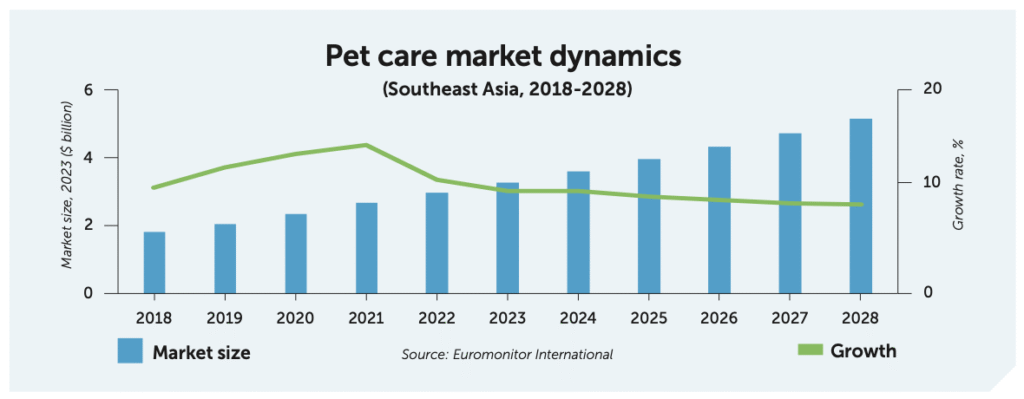
At the country level, Thailand is the largest single market, accounting for nearly half of total regional pet care sales. Indonesia recorded the fastest historical growth, tripling in market size between 2018 and 2023, while the Philippines doubled over the same period. Looking ahead, Indonesia and Vietnam are expected to post the highest CAGRs from 2023 to 2028, reflecting rapidly rising pet ownership rates in both markets (Tretyakova & Puri, 2024).
- This broad market expansion directly drives demand for pet air transport solutions. Three interconnected trends are fueling growth in the pet relocation segment:
- Rising cross-border mobility: Expanding intra-ASEAN labor migration, expatriate assignments, and international pet travel have increased the volume of pets transported by air each year. Vietnam Briefing (2025) reported that cross-border pet relocation orders in Ho Chi Minh City alone grew 22% year-over-year in 2025.
- Premiumization and humanization: As pet owners increasingly view pets as family members, they are willing to pay a premium for safe, humane, and airline-compliant transport solutions, rather than low-cost non-compliant alternatives.
- E-commerce channel growth: The online pet care channel is projected to double in size across Southeast Asia by 2028 (Tretyakova & Puri, 2024), creating new distribution opportunities for specialized pet travel products including IATA-compliant crates.
Despite this strong demand, the supply of fully certified pet air crates remains extremely limited across the region. Most local products are designed for everyday car travel and fail to meet international air transport standards, creating a clear market opportunity for wholesale suppliers of compliant, cost-effective solutions.
Regulatory Landscape: IATA Compliance as a Unified Regional Standard
While pet import and quarantine regulations vary across ASEAN member states, nearly all commercial airlines operating in the region — including flag carriers and international airlines — enforce container standards set forth in the 51st edition of the IATA Live Animals Regulations (LAR) (International Air Transport Association [IATA], 2024).
Core IATA LAR requirements for pet air crates include:
- Rigid structural design capable of withstanding stacking and handling during air transit
- Secure mesh doors with appropriately sized openings to prevent escape and injury
- Ventilation on all four sides to ensure adequate airflow
- Rounded internal edges and non-toxic materials to protect animal welfare
- Built-in food and water access points for long-haul flights
Field research in Vietnam confirms that over 80% of locally available pet crates do not meet these requirements. Common failures include insufficient structural rigidity that leads to deformation during handling, mesh spacing that violates escape-prevention standards, and inadequate ventilation coverage. As a result, pet relocation companies and air cargo agents regularly face shipment rejection, surcharges, or customer complaints when using local products.
For wholesale distributors, sourcing a product line certified to the unified IATA LAR standard delivers three key advantages. First, it eliminates the need to stock separate SKUs for different national markets, reducing inventory complexity and costs. Second, it minimizes regulatory and liability risk for resellers, as the product meets the baseline standard accepted by all major airlines. Third, it positions distributors as premium, solution-focused suppliers rather than low-cost commodity resellers, supporting higher margin positioning.
Vietnam: On-Ground Insights and Regional Distribution Hub Potential
On-ground research conducted in Ho Chi Minh City in 2026 yielded four key findings:
- Fast-growing relocation demand: International pet relocation orders in Ho Chi Minh City grew 22% year-over-year in 2025, with routes to Europe, North America, and Australia representing the highest-margin, most compliance-sensitive segments (Vietnam Briefing, 2025).
- Low local compliance rates: Only an estimated 20% of pet crates sold in the Vietnamese market meet full IATA LAR standards. Most buyers — both retail consumers and B2B logistics firms — settle for substandard products due to limited availability of certified alternatives.
- Regional hub role: Vietnamese pet product wholesalers already serve secondary markets including Cambodia, Laos, and Myanmar, leveraging geographical proximity and established cross-border trade channels. A single IATA-compliant product line can therefore reach a multi-country customer base through Vietnamese distribution partners.
- Clear procurement priorities: When evaluating pet air crate suppliers, Vietnamese B2B buyers rank full certification as their top priority, followed by size range coverage, durable stainless steel doors, wholesale pricing, and lead time. Buyers consistently express frustration with suppliers that cannot provide verifiable compliance documentation or offer limited size options.
These findings indicate that Vietnam is both a strong standalone market and an effective launchpad for broader ASEAN expansion. Distributors that enter the Vietnamese market with a complete, certified product line can quickly capture share and expand regionally through existing trade networks.
Starvey Global IATA-Compliant Pet Crates: Product-Market Fit for ASEAN Wholesalers
Starvey Global’s full series of IATA-compliant pet air crates is engineered to address the specific pain points of Southeast Asian wholesale buyers, combining full regulatory certification, broad size coverage, durable construction, and flexible commercial terms.
The complete product line includes 9 distinct size models, accommodating everything from small cats and toy breeds to extra-large working dog breeds. The two flagship wholesale SKUs are the SG-CR-565 and SG-CR-810, both featuring heavy-duty stainless steel doors for maximum durability and airline acceptance.
Key wholesale value propositions include:
- Full IATA LAR 51st edition compliance: All models are designed and tested to meet the full structural, ventilation, and safety requirements of the IATA Live Animals Regulations, ensuring acceptance by all major international and regional airlines. This eliminates the core compliance risk for distributors and their logistics customers.
- 9-size full-line coverage: With 9 SKUs covering all common pet size categories, distributors can source their entire pet crate assortment from a single supplier, reducing vendor management overhead and simplifying procurement. Mixed-size ordering allows partners to match inventory to local demand patterns.
- Durable, humane design: Constructed from virgin, food-grade PP material with rounded internal edges and full four-sided ventilation, the crates prioritize animal comfort and safety — aligning with the regional trend toward humane pet products. Stainless steel doors on core models resist corrosion and damage, extending product lifespan and reducing warranty claims.
- Complementary accessory ecosystem: Starvey Global offers a full range of matching accessories for wholesale purchase, including hanging food bowls, mounted water dispensers, and caster wheel kits. These add-ons increase average order value and allow distributors to offer complete, ready-to-use solutions to pet relocation and retail customers.
- Flexible minimum order quantities: To accommodate distributors of all sizes, Starvey Global offers tiered MOQ terms: 200 units for single-SKU orders, and 500 units for mixed-size orders. This allows smaller regional distributors to enter the category with lower upfront inventory investment, while supporting bulk replenishment for larger wholesalers.
- OEM branding support: Starvey Global supports custom logo printing on both crates and packaging for qualifying wholesale orders, enabling distributors to build their own local brand equity and differentiate from generic competitors.
Relative to European-sourced IATA-compliant crates, Starvey Global’s products deliver equivalent certification and quality at 40–50% lower wholesale cost, with shorter lead times across Southeast Asia. This price-performance profile is particularly well suited to price-sensitive regional markets where buyers are seeking certified alternatives to both cheap local products and expensive imported European brands.
Conclusion
The Southeast Asian pet care market is entering a mature growth phase, with rising consumer expectations for safety, quality, and regulatory compliance across all product categories. For pet air crates specifically, strong demand growth from the pet relocation, air cargo, and premium retail channels stands in sharp contrast to a supply base dominated by non-compliant, low-quality local products.
IATA-compliant crates represent a high-margin, underserved wholesale niche with strong long-term fundamentals. Because the IATA LAR standard is uniformly accepted across all ASEAN markets, a single certified product line can serve buyers across the entire region, creating economies of scale for both suppliers and distributors. Vietnam, with its fast-growing domestic market and established role as a regional trade hub, is an ideal entry point for suppliers seeking to build ASEAN distribution.
Starvey Global’s 9-model IATA-compliant crate series — including the SG-CR-565 and SG-CR-810 stainless steel door models — is purpose-built to address regional market needs. Combined with flexible MOQ terms, OEM branding support, and a full accessory ecosystem, the portfolio provides wholesale partners with a complete, scalable solution to capture share in the fast-growing pet travel segment. As regional pet ownership and cross-border mobility continue to rise, fully certified, humanely designed pet transport products will become an increasingly core category for pet product distributors across Southeast Asia.